
Festival Stall Order
Imagine a festival game where you are trying to keep everything in the best order. In Festival Stall Order, you are trying to work toward the right list by following one clear idea.
You are given numbers, words, or labels that are not in the right order yet. Your task is to rearrange them so they line up the way the problem wants. That usually means comparing values carefully and making sure nothing gets lost or changed by mistake. After you finish, the result should feel neat and easy to read.
For example, if the input is nums = [13], the answer is [13]. A single stall stays unchanged because the identifiers were already ordered. Another example is nums = [21,8,21,4], which gives [4,8,21,21]. Shared stalls keep both entries while the list climbs from smallest to largest.
This is a friendly practice problem, but it still rewards careful reading. Keep your eye on the order from start to finish, and make sure the final list is exactly how the question wants it.
Example Input & Output
A single stall stays unchanged because the identifiers were already ordered.
Shared stalls keep both entries while the list climbs from smallest to largest.
Negative placeholders and duplicates remain visible in ascending order.
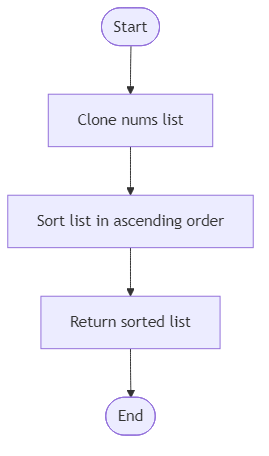
Algorithm Flow
Best Answers
import java.util.*;
class Solution {
    public int[] sort_stalls(int[] nums) {
        int[] res = nums.clone();
        Arrays.sort(res);
        return res;
    }
}Comments (0)
Join the Discussion
Share your thoughts, ask questions, or help others with this Challenge.