
Subarray Sum Equals K
You are given an array and a target value k. The goal is to count how many contiguous subarrays have sum exactly equal to k.
This is important: the subarray must be continuous. Also, the answer is a count, not the longest length and not the actual subarrays themselves.
For example, if nums = [1,1,1] and k = 2, the answer is 2 because the subarrays [1,1] at positions (0,1) and (1,2) both work. If nums = [1,2,3] and k = 3, the answer is 2 because both [1,2] and [3] match.
So the task is to count every continuous segment whose total is exactly k.
Example Input & Output
Subarrays [1,1] at positions (0,1) and (1,2).
Subarrays [1,2] and [3].
Subarrays [1,-1], [0], and [1,-1,0].
Algorithm Flow
Solution Approach
The standard hash table solution uses prefix sums. Let prefix mean the sum of all numbers from the start of the array up to the current position.
If a subarray from index j + 1 to i has sum k, then:
Rearranging that gives:
That is the key idea. While scanning the array, if the current prefix sum is prefix, then any earlier prefix sum equal to prefix - k creates a valid subarray ending at the current index.
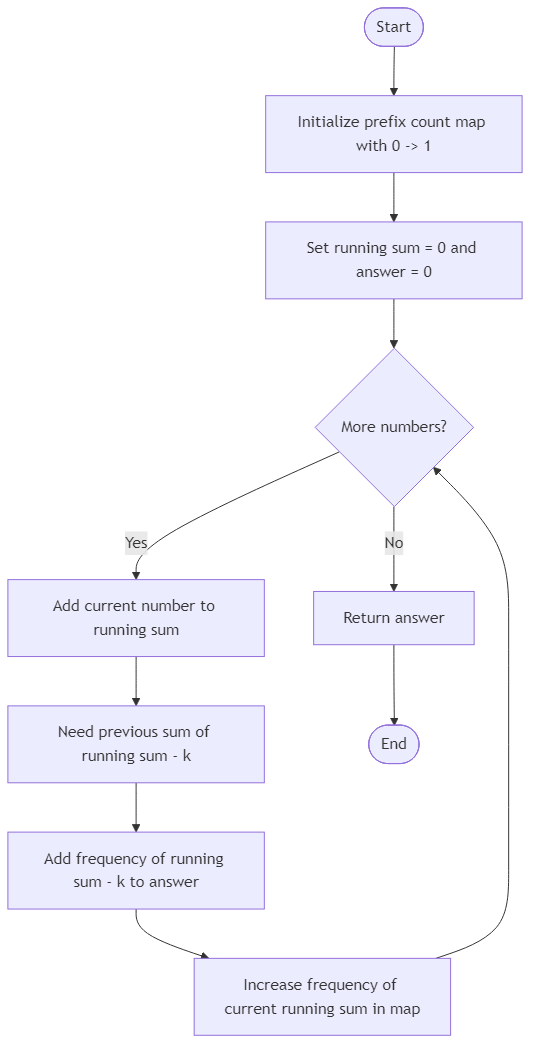
So we keep a map from prefix sums to how many times each one has appeared so far. Before the loop starts, set map[0] = 1 so subarrays starting at index 0 are counted correctly.
At each number, update the running prefix sum, add map[prefix - k] to the answer if it exists, then record the new prefix sum in the map.
This works even with negative numbers, which is why it is better than a simple sliding window here. The time complexity is O(n), and the extra space is O(n) in the worst case.
Best Answers
import java.util.*;
class Solution {
    public int subarray_sum_equals_k(int[] nums, int k) {
        Map<Integer, Integer> count = new HashMap<>();
        count.put(0, 1);
        int s = 0, ans = 0;
        for (int x : nums) {
            s += x;
            ans += count.getOrDefault(s - k, 0);
            count.put(s, count.getOrDefault(s, 0) + 1);
        }
        return ans;
    }
}Comments (0)
Join the Discussion
Share your thoughts, ask questions, or help others with this Challenge.