
Warehouse Palette Order
In Warehouse Palette Order, you are given an array of integers and need to return those same integers sorted from smallest to largest.
The task is only about reordering. You should not remove duplicates, skip negative values, or transform the numbers in any way. Every value from the input should still appear in the output, just placed in ascending numeric order.
For example, nums = [5,1,5,3] should become [1,3,5,5]. Both copies of 5 stay in the result. Another useful example is nums = [2,-3,2,0], which should become [-3,0,2,2]. That shows that negative numbers come before zero and positive values when they are smaller.
If the array is empty, return an empty array. If the array contains only one number, that single value is already sorted. So the task is simply to return the full list arranged in ascending numeric order.
Example Input & Output
A single value stays the same because an array with one element is already sorted.
Both copies of 5 remain while the numbers are reordered from low to high.
Negative values, zero, and duplicates all follow normal numeric order.
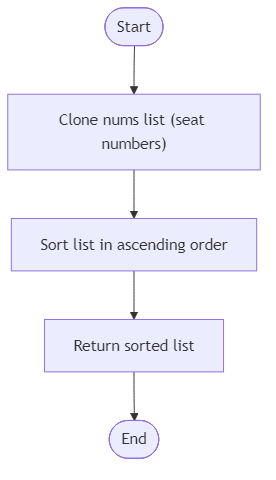
Algorithm Flow
Solution Approach
A direct numeric sort is the best fit for this problem. The input is already a plain array of integers, and the expected output is just those same integers arranged from smallest to largest. There is no extra constraint like keeping track of original indices or implementing a custom ordering rule, so the solution can stay very focused.
The only thing you really need to be careful about is how sorting works in your language. In JavaScript, for example, calling sort() without a comparator can compare elements as strings instead of numbers. That would break cases like [10, 9, 8] or any array that contains multi-digit values. To prevent that, you should use an explicit numeric comparator.
A clean JavaScript version looks like this:Here, the spread operator copies the input array so the original data does not get modified. The comparator a - b ensures the array is sorted by numeric value. If a is smaller, it should come earlier. If a and b are equal, both remain in place as separate items, which naturally preserves duplicates.
This handles all of the example shapes without extra effort. Empty arrays stay empty. One-element arrays remain unchanged. Repeated numbers like [5, 1, 5, 3] come back as [1, 3, 5, 5]. Mixed arrays with negative values such as [2, -3, 2, 0] are sorted correctly because negative numbers compare as smaller than zero and positive numbers.
The time complexity is O(n log n), which is standard for comparison-based sorting. The extra space depends on whether you sort in place or work on a copy first, but the overall idea stays the same in both versions.
So the full strategy is simple: copy the palette list if needed, apply an ascending numeric sort with an explicit comparator, and return the sorted array with all values preserved.
Best Answers
import java.util.*;
class Solution {
    public int[] warehouse_palette_order(int[] nums) {
        int[] res = nums.clone(); Arrays.sort(res); return res;
    }
}Comments (0)
Join the Discussion
Share your thoughts, ask questions, or help others with this Challenge.