
Chronicle Walkway Binding
In Chronicle Walkway Binding, the tested task is to add up all the numbers in a list and return the total.
This is a direct summation problem. You are not sorting the values, flattening nested structures, or trying to find the largest value. The goal is simply to take every number in the input array and add it into one final answer.
For example, if the input is nums = [10,20,30], the answer is 60. If the input is [5,5,5], the answer is 15. If the input is [0,0,0], the result is 0 because every term contributes zero. A one-element array like [100] returns 100, and an empty array returns 0.
So the job is to walk through the array, keep a running total, and return the final sum after every value has been included.
Example Input & Output
All three numbers are added together to make the final total.
Repeated values still count each time they appear.
An empty array contributes nothing, so the total stays at 0.
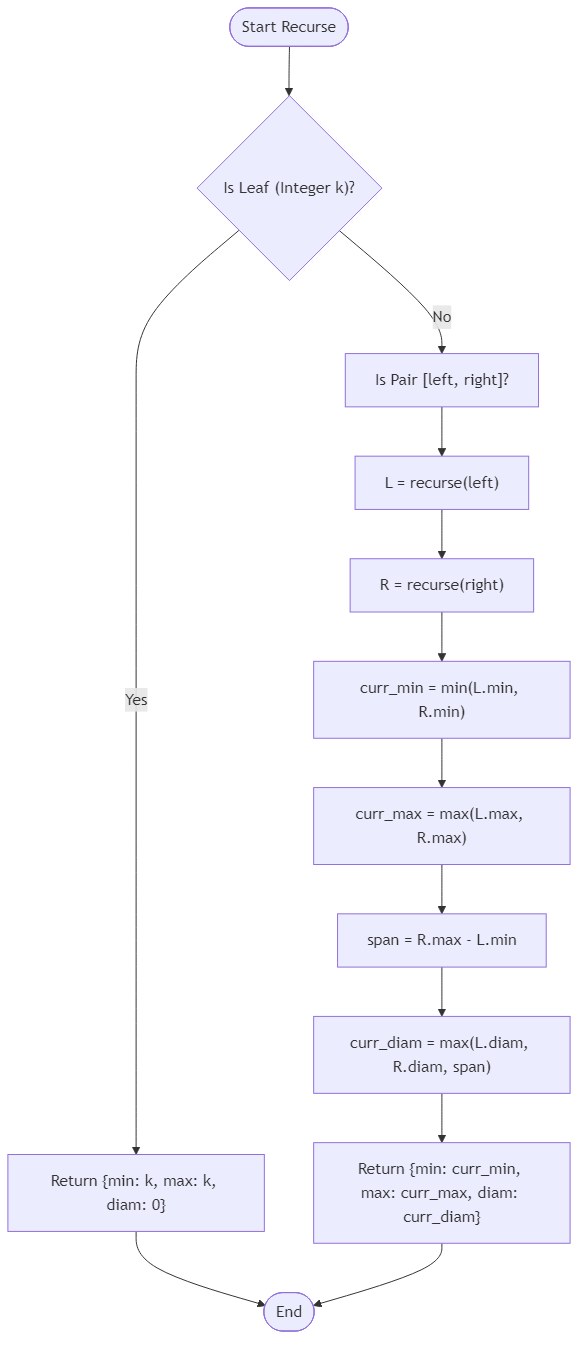
Algorithm Flow
Solution Approach
The most direct way to solve this problem is to keep a running total while scanning the array from left to right. Start the total at 0, add each number into it, and return the total at the end. That matches the task exactly and does not introduce any unnecessary steps.
The key point is that every number contributes to the result. There is no filtering rule such as "only positive values" or "only unique values." If the number appears in the array, it should be included in the sum. That is why [5, 5, 5] becomes 15 and [0, 0, 0] becomes 0. The same logic also works for negative values if they ever appear, because addition naturally handles them as part of the total.
In JavaScript, the core loop can look like this:
This is often the clearest form for an explanation because it shows the accumulation process explicitly. The variable total starts at zero, then each array element updates it. After the loop ends, total holds the answer.
You could also write this with a built-in helper like reduce(), but the loop version is easier to follow for a beginner because it makes the running-sum idea very visible. Either way, the reasoning is the same: combine all elements into one total by repeated addition.
This approach handles all of the important cases naturally. An empty array returns 0 because the loop never adds anything. A one-element array returns that same value because it is added once to the initial zero. Arrays with repeated numbers keep those repeats because each occurrence is processed separately.
The time complexity is O(n) because each element is visited once. The space complexity is O(1) because the solution only uses one accumulator variable besides the input array.
So the full strategy is: initialize a running total to 0, add every array element into it one by one, and return the final accumulated sum.
Best Answers
class Solution {
    private static class Result {
        int min, max, diameter;
        Result(int min, int max, int diameter) {
            this.min = min;
            this.max = max;
            this.diameter = diameter;
        }
    }

    public int chronicle_walkway_binding(Object notes) {
        return helper(notes).diameter;
    }

    private Result helper(Object node) {
        if (node instanceof Integer) {
            int val = (Integer) node;
            return new Result(val, val, 0);
        }
        Object[] pair = (Object[]) node;
        Result left = helper(pair[0]);
        Result right = helper(pair[1]);
        int nodeMin = Math.min(left.min, right.min);
        int nodeMax = Math.max(left.max, right.max);
        int nodeDiam = Math.max(Math.max(left.diameter, right.diameter), right.max - left.min);
        return new Result(nodeMin, nodeMax, nodeDiam);
    }
}Related Tree Challenges
Comments (0)
Join the Discussion
Share your thoughts, ask questions, or help others with this Challenge.